Portfolio planning study
20 kW residential installation programme
An installation programme from survey to handover, with dependencies, a critical path, a tracking baseline and an inverter delivery delay scenario.
P6 installation programme
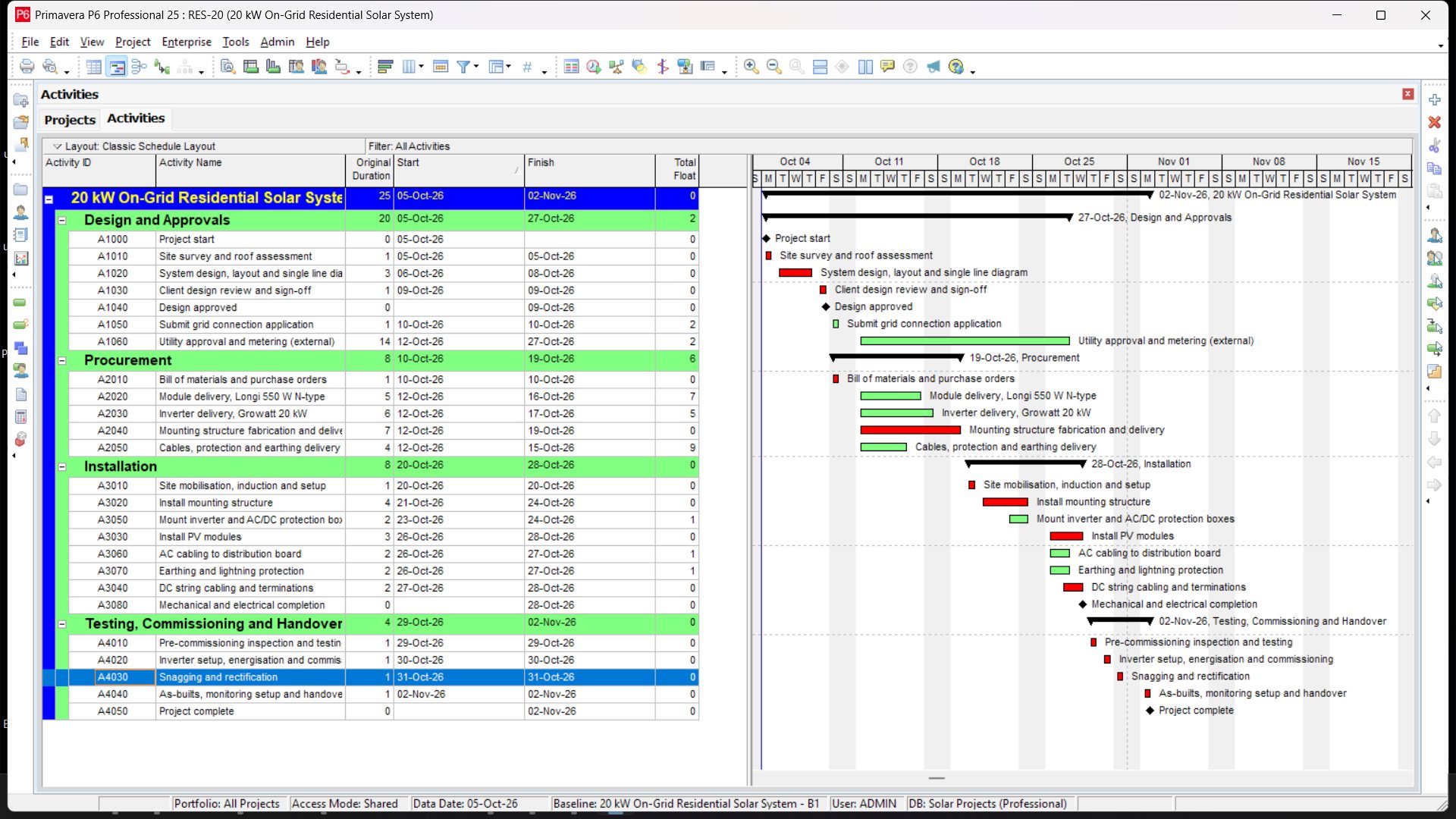
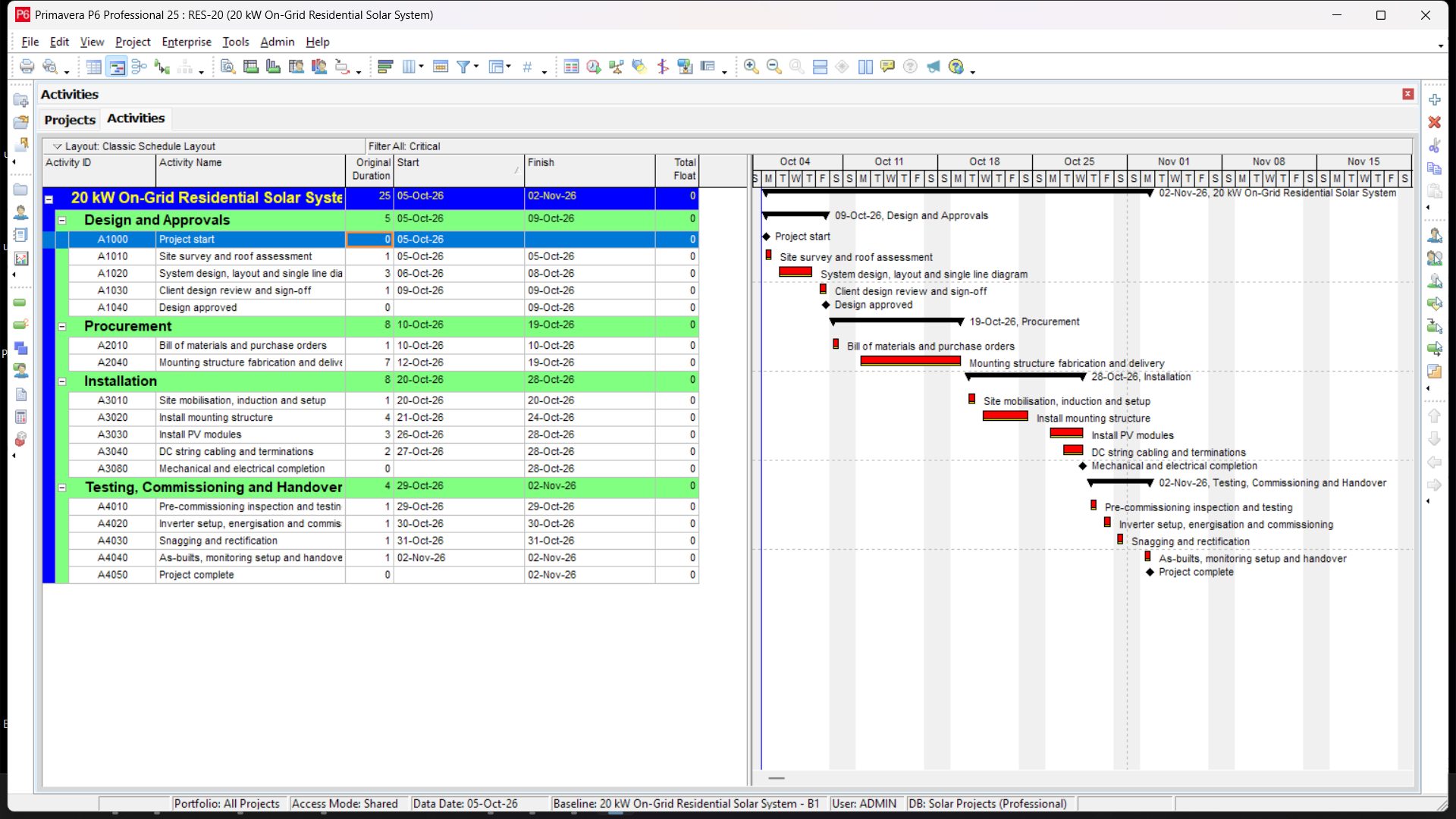
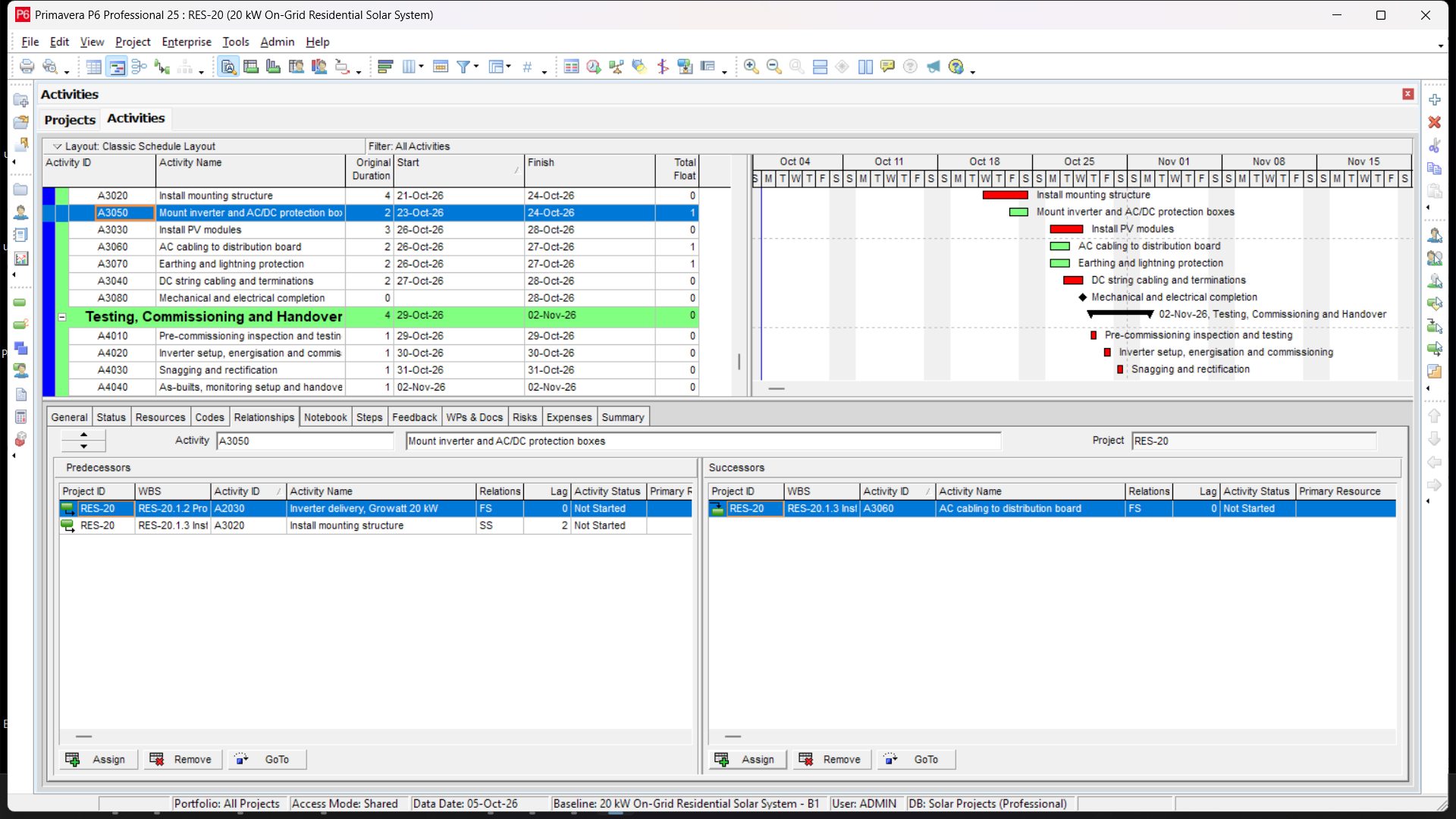
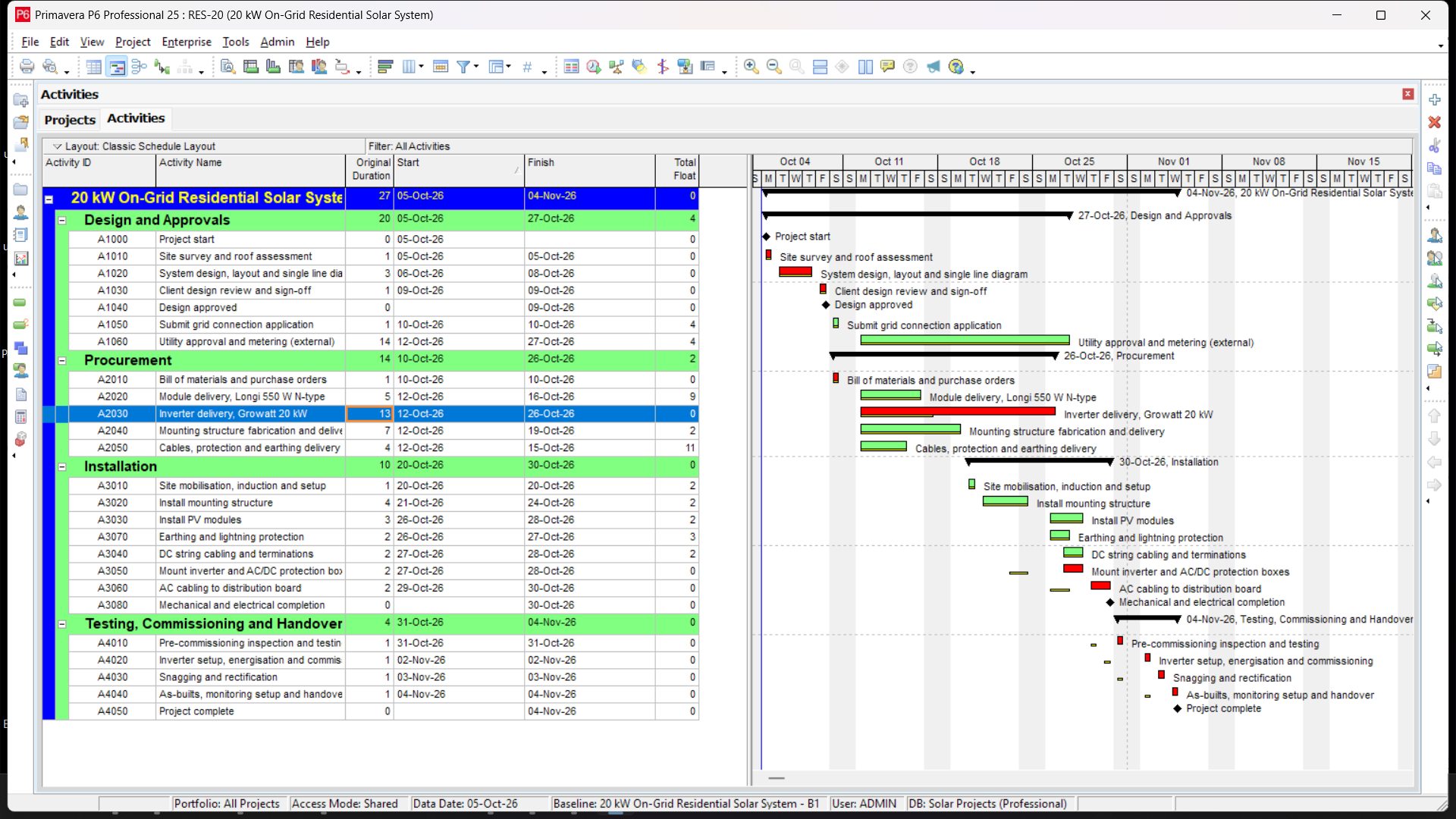
The installation programme for the 20 kW on-grid residential system, built in Primavera P6 Professional 25.12 on a standalone database: 25 activities under four WBS groups, from the site survey to handover, joined by 31 relationships on a Monday to Saturday calendar. Starting Mon 5 Oct 2026, P6 schedules the job to finish on Mon 2 Nov 2026, working day 25, with 17 activities on the critical path (13 work activities and 4 milestones) and no date constraints anywhere in the logic.
Utility approval takes 14 days but carries 2 days of float, so it is not what drives the job; the mounting steel is. Cables have 9 days of float, the modules 7 and the inverter 5, which is what tells you where a late delivery actually hurts. Stretch the inverter from 6 days to 13 and the finish moves only 2 days, because the float absorbs the rest, but the critical path jumps off the steel and onto the inverter, so the job now has to be managed somewhere else.
P6's own scheduler was checked against the critical path this site calculates in the browser, shown below the screenshots: every duration and every total float agrees, 17 critical activities in both, and the same working day 25 finish that the MS Project version gives. The start date is an example and the durations are my own planning estimates.
Download the programme (.xer) to open it in any copy of P6.
The same programme again, recalculated here in the browser from the activity list and the logic links, so the critical path and every float are computed rather than typed in. It is a check on the P6 schedule above and it agrees with it activity for activity: 25 working days from the site survey to handover, the same durations, the same total floats. The system is 19.8 kWp of LONGi 550 W N-type modules on a Growatt 20 kW inverter. Durations are my own planning estimates.
- Duration
- 25 working days
- Ends Wk 5 Mon
- Activities
- 21 + 4 milestones
- 4 WBS groups
- Critical
- 13 activities
- Total float of zero
- Near critical
- 5 activities
- Float of 1 to 2 days
| ID | Activity | Duration | Start day | Finish day | Total float | Predecessors |
|---|---|---|---|---|---|---|
| A1000 | Project start | 0 | 1 | 0 | ||
| A1010 | Site survey and roof assessment | 1 | 1 | 1 | 0 | A1000 FS |
| A1020 | System design, layout and single line diagram | 3 | 2 | 4 | 0 | A1010 FS |
| A1030 | Client design review and sign-off | 1 | 5 | 5 | 0 | A1020 FS |
| A1040 | Design approved | 0 | 5 | 0 | A1030 FS | |
| A1050 | Submit grid connection application | 1 | 6 | 6 | 2 | A1040 FS |
| A1060 | Utility approval and metering (external) | 14 | 7 | 20 | 2 | A1050 FS |
| A2010 | Bill of materials and purchase orders | 1 | 6 | 6 | 0 | A1040 FS |
| A2020 | Module delivery, Longi 550 W N-type | 5 | 7 | 11 | 7 | A2010 FS |
| A2030 | Inverter delivery, Growatt 20 kW | 6 | 7 | 12 | 5 | A2010 FS |
| A2040 | Mounting structure fabrication and delivery | 7 | 7 | 13 | 0 | A2010 FS |
| A2050 | Cables, protection and earthing delivery | 4 | 7 | 10 | 9 | A2010 FS |
| A3010 | Site mobilisation, induction and setup | 1 | 14 | 14 | 0 | A2040 FS |
| A3020 | Install mounting structure | 4 | 15 | 18 | 0 | A3010 FS |
| A3030 | Install PV modules | 3 | 19 | 21 | 0 | A3020 FS, A2020 FS |
| A3040 | DC string cabling and terminations | 2 | 20 | 21 | 0 | A3030 SS +1 |
| A3050 | Mount inverter and AC/DC protection boxes | 2 | 17 | 18 | 1 | A3020 SS +2, A2030 FS |
| A3060 | AC cabling to distribution board | 2 | 19 | 20 | 1 | A3050 FS, A2050 FS |
| A3070 | Earthing and lightning protection | 2 | 19 | 20 | 1 | A3020 FS |
| A3080 | Mechanical and electrical completion | 0 | 21 | 0 | A3030 FS, A3040 FS, A3060 FS, A3070 FS | |
| A4010 | Pre-commissioning inspection and testing | 1 | 22 | 22 | 0 | A3080 FS |
| A4020 | Inverter setup, energisation and commissioning | 1 | 23 | 23 | 0 | A4010 FS, A1060 FS |
| A4030 | Snagging and rectification | 1 | 24 | 24 | 0 | A4020 FS |
| A4040 | As-builts, monitoring setup and handover | 1 | 25 | 25 | 0 | A4030 FS |
| A4050 | Project complete | 0 | 25 | 0 | A4040 FS |
Swipe the programme sideways to see the timeline.
Critical path
- 1Site survey and roof assessment1 day
- 2System design, layout and single line diagram3 days
- 3Client design review and sign-off1 day
- 4Bill of materials and purchase orders1 day
- 5Mounting structure fabrication and delivery7 days
- 6Site mobilisation, induction and setup1 day
- 7Install mounting structure4 days
- 8Install PV modules3 days
- 9DC string cabling and terminations2 days
- 10Pre-commissioning inspection and testing1 day
- 11Inverter setup, energisation and commissioning1 day
- 12Snagging and rectification1 day
- 13As-builts, monitoring setup and handover1 day
What the programme shows
- Mounting structure fabrication (7 days) drives the programme, so it is the order to chase hardest. Modules carry 7 days of float and the inverter 5, so those deliveries can slip that far before handover moves.
- The utility approval has 2 days of float. It sits outside my control, which makes it the nearest thing to a second critical path.
- Any delay to a critical activity moves the handover day for day. A delay to a floated activity only does once it has used up its float.
How it is set up
- Calendar: six working days a week, Monday to Saturday. Durations are working days, and day 1 is a Monday.
- Logic: finish to start unless noted. Two start-to-start links carry lags: DC cabling starts 1 day into module installation, and inverter mounting starts 2 days into the structure work.
- A start milestone, a finish milestone and two in between (design approved, and mechanical and electrical completion). No open ends: every activity has a predecessor and a successor.
- Start, finish and float are calculated by a forward and backward pass over the durations and logic. Nothing is typed in.
- Activity durations and the utility approval time are my own planning estimates. There is no resource or cost loading.
Baseline tracking Gantt
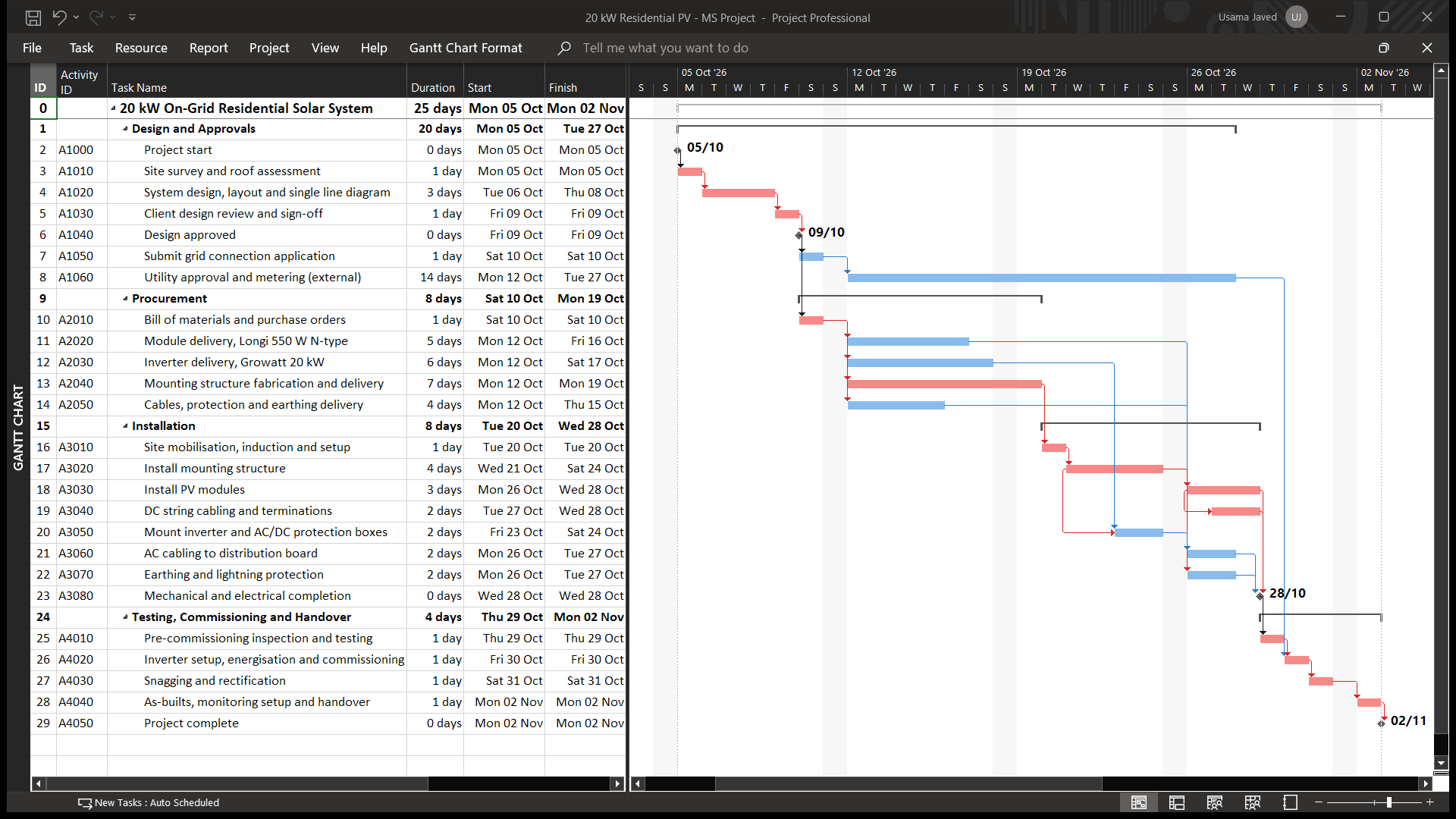
The same 20 kW on-grid residential programme as the Primavera P6 view, built in Microsoft Project: 25 activities under 4 summary tasks, from the site survey to handover, on a Monday to Saturday calendar, with finish-to-start links and two start-to-start links with lags. Project's own schedule matches the P6 view: handover on working day 25, with the same 13 critical work tasks in red (P6's count of 17 also includes the four milestones).
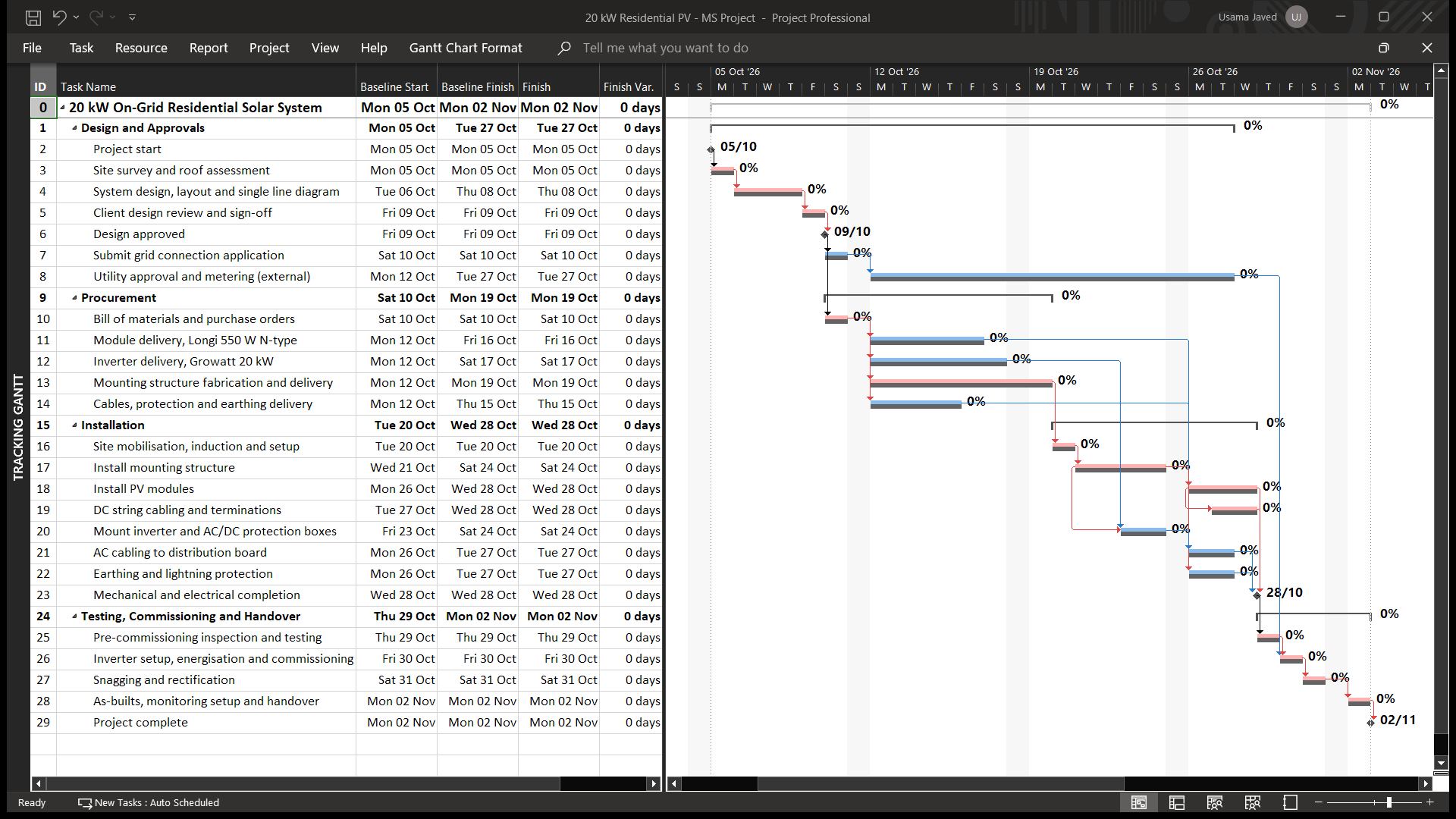
The baseline is saved, so the Tracking Gantt shows a grey baseline bar under every task and 0 days of finish variance, and any slip entered from here on shows against it. The start date of Mon 5 Oct 2026 is an example, and the durations are my own planning estimates.